
You glance down at your hand, where a bespoke ring catches the morning light, and for a fleeting second, you wonder if that central sapphire is held quite as securely as the day you first slid it onto your finger. It is more than just gold and gemstone; it is a physical archive of a promise made or a milestone reached, making the ritual of caring for bespoke jewellery an act of profound stewardship. It's perfectly natural to feel a flutter of anxiety about preserving something so irreplaceable, especially when you're unsure which gentle habits will protect its lustre and which might accidentally cause harm.
I understand that your jewellery represents a unique chapter of your life, and I am here to guide you through protecting both its physical integrity and its sentimental soul. You will discover how to maintain the brilliance of your one-of-a-kind commissions using expert, artisanal techniques that respect the delicate nature of handcrafted work. We shall walk through a simple daily routine, clarify the safest home-cleaning methods, and identify the vital signs that suggest it's time to return your piece to the workshop for professional care.
Key Takeaways
- Understand why bespoke commissions require a unique approach to care, focusing on the specific mineral properties of natural gemstones and delicate hand-finished details.
- Adopt the "Last On, First Off" daily ritual to protect your 18ct gold and gems from household chemicals, ensuring that caring for bespoke jewellery becomes a natural part of your morning.
- Learn to organise your jewellery box as a protective sanctuary, preventing the accidental scratches and surface damage that occur when pieces are stored too closely together.
- Master the "Artisan Soak" at home using gentle, fragrance-free methods to safely restore the brilliance of your stones without risking the integrity of their settings.
- Identify when to seek a professional health check for your heirlooms to ensure claws and bezels remain secure, preserving the story of your piece for generations to come.
The Philosophy of Stewardship: Why Bespoke Jewellery Requires Unique Care
When you receive a one-of-a-kind commission, you aren't simply becoming an owner; you are becoming a steward of a personal legacy. Mass-produced items are often designed for durability through uniformity, but artisanal pieces celebrate the delicate, the detailed, and the deeply personal. Caring for bespoke jewellery requires an understanding that every hand-finished curve and every unique setting has its own physical requirements. By adopting Jewellery care best practices, you ensure that the structural integrity of your piece remains as steadfast as the memories it holds. This process isn't a chore; it's a way of honouring the spirit of the design and the milestone it represents.
The Difference Between Natural and Lab-Grown Care
Natural diamonds and coloured gemstones are magnificent products of the earth, each containing a unique internal map of inclusions and mineral characteristics. These natural features mean that your stone might react differently to sudden temperature shifts or physical impact compared to a uniform, lab-grown alternative. It is a common myth that diamonds are indestructible. Whilst they sit at the top of the Mohs scale with a hardness of 10, a sharp blow at the right angle can still cause a chip along a natural cleavage plane. Knowing where your specific gemstone sits on this scale, whether it is a resilient sapphire or a slightly softer emerald, allows you to adjust your lifestyle habits to protect its face from scratches and dulling.
Bespoke vs. Ready-to-Wear: A Different Standard
The way a piece is constructed fundamentally changes its behaviour over decades of wear. Hand-forged 18ct gold, a hallmark of bespoke engagement rings, possesses a density and resilience that mass-cast jewellery often lacks. However, this artisanal quality means the piece is a living object that will develop its own beautiful patina over time. Unlike high-street retailers who offer generic advice, a bespoke designer acts as a "Trusted Guide" for the lifetime of the piece. I provide individualised support that considers the specific weight, balance, and setting style of your commission. Proper maintenance ensures that unique, one-of-a-kind settings, which may be more intricate than standard mounts, remain secure. We view the ritual of caring for bespoke jewellery as the next vital chapter in your story, ensuring the essence of the work is preserved for the next generation.
- Intricate Details: Hand-finished elements require gentle handling to avoid snagging or bending.
- Natural Signatures: Inclusions in natural stones are part of their soul but can be sensitive to ultrasonic cleaners.
- Structural Integrity: Regular checks prevent the heartbreak of a loose stone in a unique, non-standard setting.
Daily Rituals: Protecting Your Commission from the Elements
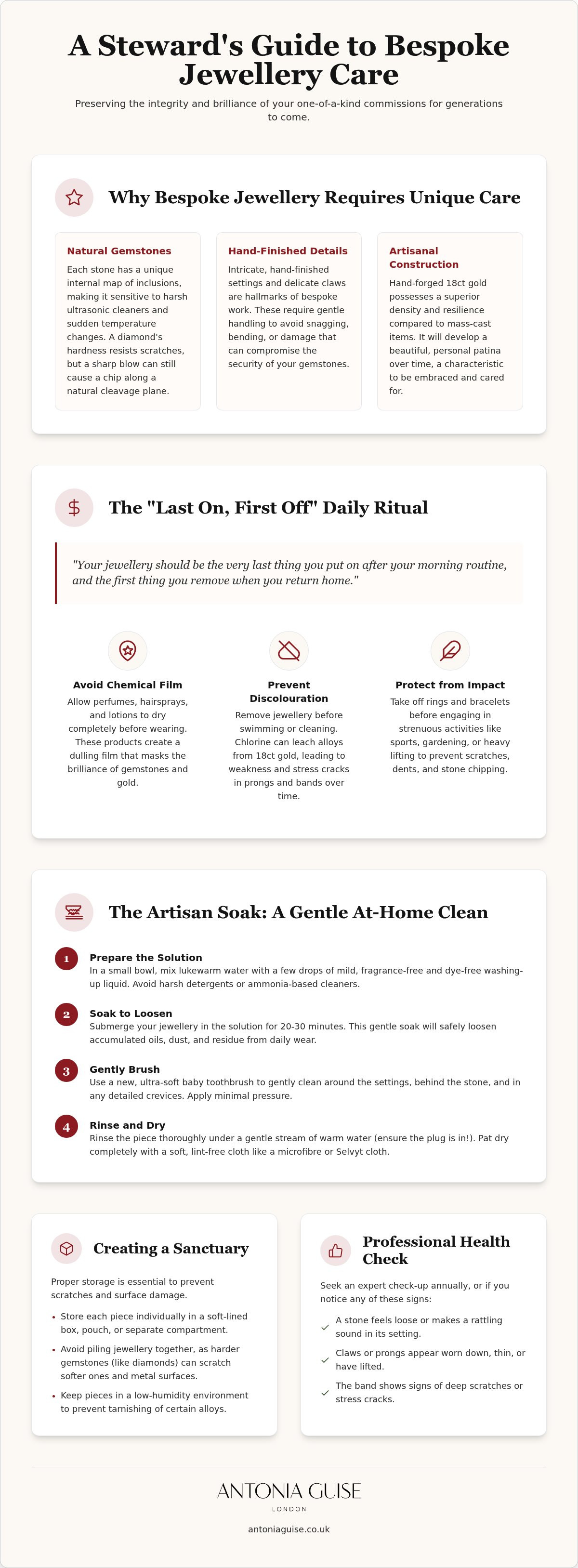
Caring for bespoke jewellery is most effective when it's woven into the quiet, rhythmic moments of your day. Your one-of-a-kind piece was crafted to be worn and loved, yet it remains sensitive to the environment. The most vital habit you can adopt is the "Last On, First Off" rule. This simple ritual ensures your jewellery is the very last touch of your morning routine and the first thing you remove when you return home. By doing so, you shield your commission from the invisible elements that threaten its brilliance.
Perfumes, hairsprays, and rich body lotions are the primary culprits behind a dulling film on natural gemstones. These substances settle into the microscopic crevices of hand-finished settings, attracting dust and masking the stone's fire. Following expert advice on jewellery care, you should allow all beauty products to dry completely on your skin before putting on your rings or necklaces. This small pause preserves the lustre of 18ct gold and keeps your stones singing with light.
Chemical Vulnerabilities and Discolouration
Gold alloys, whilst resilient, are not immune to chemical reactions. Chlorine is a particularly aggressive enemy; it can actually leach the base metals from 18ct gold, potentially leading to stress cracks in delicate prongs or bands. Hand sanitizers, though essential, often contain harsh alcohols that can dry out certain organic gems or leave a stubborn residue on polished metal. If you must use these products in public, try to apply them away from your rings, or wait until your hands are completely dry before sliding your jewellery back on. If you ever feel your piece has lost its spark, a quick chat about bespoke maintenance can help restore its original glow.
Physical Protection During Activity
Bespoke pieces are often defined by their intricate, sculptural details, which can be vulnerable during high-intensity movement. Gardening, weightlifting, or even heavy household cleaning can subject your jewellery to "impact damage" or "metal on metal" friction. A gold band can easily be misshapen by the grip of a heavy barbell, and a natural diamond, despite its hardness, can chip if struck against a granite countertop. It's also wise to remove delicate chains and drop earrings before sleep. Tossing and turning can cause fine links to stretch or snap, and intricate settings may snag on bed linens, compromising the security of your stones.
- Kitchen Hazards: Remove rings before kneading dough or handling raw ingredients to prevent organic matter from becoming trapped.
- The Gym: Always leave your jewellery in a soft pouch before starting a workout to avoid scratches from equipment.
- Swimming: Both salt water and pool chemicals can dull the finish of your metal and weaken the structure of your settings.
Creating a Sanctuary: Organising Your Jewellery Box for Longevity
Your bespoke jewellery does not stop being precious the moment you take it off. It requires a dedicated space that reflects the care put into its creation, acting as a sanctuary for the stories you carry. A thoughtfully curated jewellery box acts as the first line of defence against the silent threats of scratches, tangles, and atmospheric wear. When we discuss caring for bespoke jewellery, we are describing a commitment to providing a home where every piece is cushioned by a soft, fabric-lined interior. For collectors who apply this same level of care to their watches, high-quality storage and winding solutions from aevitas-uk.co.uk provide the ideal environment. This gentle environment prevents the metal-on-metal friction that can dull a hand-polished finish or wear down the delicate milgrain details of an artisanal setting.
One of the most frequent mistakes in jewellery storage is the "diamond on diamond" approach. Whilst diamonds are famously resilient, they are also the only material capable of scratching another diamond. If two bespoke rings are left to rattle together in a shared tray, they will inevitably leave permanent surface marks on one another. To avoid this heartbreak, ensure every individual item has its own partitioned home. If your box lacks enough compartments, small, breathable silk or cotton pouches offer an elegant solution for keeping your treasures separate and secure.
The Ideal Environment for Natural Gems
Natural gemstones are living archives of geological history, and many are sensitive to the world around them. Direct sunlight can cause certain coloured stones to fade or lose their vibrancy over years of exposure, whilst extreme temperature fluctuations can stress the stone's structure. Humidity also plays a vital role; organic gems like pearls or opals require a hint of moisture from the air to prevent them from becoming brittle. Following professional stewardship and care for your jewelry means keeping your sanctuary in a cool, stable place away from radiators or damp windowsills. This intentionality ensures that the spirit of the design remains unchanged by the passage of time.
Organising by Metal and Stone Type
Tarnish is a chemical reaction that can be surprisingly contagious within a confined space. If you store sterling silver alongside your 18ct gold commissions, the gases that cause silver to darken can sometimes migrate, affecting the lustre of your gold pieces. It is best to keep different metals in their own designated zones. For necklaces and fine chains, coiling them loosely in a flat compartment or hanging them individually prevents the frustrating kinks and knots that can lead to snapped links. For those milestone pieces you wear only on the most significant occasions, wrapping them in acid-free tissue provides an extra layer of protection against the elements, preserving their brilliance for the next chapter of your story.
- Dedicated Spaces: Use a box with individual slots for rings and hooks for necklaces to prevent entanglement.
- Soft Linings: Ensure all surfaces are covered in non-abrasive materials like velvet or microfibre to cushion artisanal details.
- Climate Control: Store your jewellery box in a bedroom or dressing room rather than a humid bathroom to protect metal integrity.
The Art of the Gentle Clean: Safe Methods for Your Home
Restoring the original brilliance of your commission is a quiet, intimate ritual that allows you to reconnect with the intricate details of your piece. Whilst daily wear can lead to a subtle accumulation of oils and dust, the process of caring for bespoke jewellery at home should always be underpinned by gentleness. Your jewellery is a tactile archive of your history, and maintaining its lustre is an act of preserving that story. Unlike mass-produced items, artisanal settings often feature delicate hand-finished textures that require a more considered approach than a simple wipe with a dry cloth.
The most effective method for reviving natural diamonds and many coloured gemstones is what we call the "Artisan Soak." This involves immersing your piece in a solution of warm water mixed with a few drops of mild, fragrance-free detergent. It's vital to avoid the "indestructible" myth here; whilst the stones are ancient and resilient, the settings that hold them are precise works of art. You should also be wary of ultrasonic cleaners. The high-frequency vibrations that these machines use can agitate natural inclusions within gemstones or loosen the delicate claws of an antique-style setting, potentially leading to the heartbreak of a lost stone.
Step-by-Step Home Cleaning Guide
The ideal soak begins with water that is comfortably warm to the touch, similar to the temperature of a gentle bath. After allowing your piece to rest in the solution for ten minutes, use a soft-bristled baby toothbrush to gently lift away any residue. Focus your attention behind the gemstone where lotions and oils tend to accumulate, as this is often the secret to restoring a stone's fire. The final rinse must be thorough, using clean, lukewarm water to ensure no soapy film remains to cloud the gemstone's surface. To finish, pat the piece dry with a lint-free cloth, being careful not to snag any fine claws or intricate metalwork.
Stones That Require Extra Caution
Not all treasures respond well to immersion. Porous stones and organic gems, such as pearls or opals, should never be submerged in water as they can absorb liquids, leading to permanent discolouration or cracking. Emeralds also require a specialist touch; many are traditionally treated with natural oils to enhance their clarity, and harsh detergents can strip these away, leaving the stone looking dull and brittle. For these delicate chapters of your collection, a damp, soft cloth is the only tool you should use. If you ever feel a stone move or notice a setting looks askew during your cleaning ritual, it is time to put the brush down and contact me for professional guidance.
- The Right Tools: Always use a new, soft-bristled baby toothbrush to avoid introducing old contaminants to your gold.
- Safe Drying: Avoid paper towels, which contain abrasive fibres that can cause micro-scratches on 18ct gold.
- Rinsing Security: Always close the sink drain or use a bowl for rinsing to prevent any accidental loss of your jewellery.
Professional Stewardship: Ensuring the Integrity of Your Heirloom
Professional stewardship is the final, essential chapter in the life of your commission. Whilst your daily rituals and a dedicated sanctuary provide the foundation for preservation, the expert eye of a master artisan ensures the structural longevity of your piece for generations. The journey of caring for bespoke jewellery is a partnership between you and your designer, a shared commitment to protecting the physical archive of your most precious memories. An "Annual Health Check" is not merely a maintenance task; it is a moment to validate the condition of your treasure and ensure its story remains uninterrupted by the passage of time.
This level of professional oversight is particularly vital for jewellery remodelling projects. When we transform heritage gold and stones into a new design, we are working with materials that have already lived a lifetime. Transformed metals can occasionally exhibit subtle signs of metal fatigue or microscopic stress points that are invisible to the naked eye. Regular professional inspections allow me to monitor how these elements are settling into their new form, ensuring that the bond between the old soul and the new design remains unbreakable.
What Happens During a Professional Service?
During a professional service, I use high-magnification loupes to peer into the soul of the setting, spotting microscopic fractures or wear on the claws before they become structural failures. We meticulously check the security of every bezel and clasp, tightening any component that has been affected by the rhythmic movements of daily life. This is also when we can restore that original boutique lustre through professional polishing. Unlike home cleaning, this process involves specialist tools that can safely remove fine surface scratches from 18ct gold, returning the metal to its initial, celebratory glow. It is the ultimate act of caring for bespoke jewellery, providing the peace of mind that only expert validation can offer.
When to Seek Immediate Intervention
Between your annual visits, you should remain mindful of the subtle signals your jewellery might send. One of the most effective ways to check your piece is the "rattle test." Hold your ring or pendant close to your ear and tap the band gently with your finger. If you hear a faint, metallic clicking sound, it is a sign that a stone has become loose in its setting. Similarly, if you notice a claw is catching on your favourite knitwear or a silk scarf, the metal has likely lifted or shifted. You should never attempt to "bend" a setting back into place yourself, as 18ct gold can be brittle if manipulated without the correct heat or tools. If you notice any change in the tactile feel of your piece, seek professional help immediately to prevent the heartbreak of a lost stone.
- The Rattle Test: A simple audible check that can save a precious natural gemstone from being lost.
- Catching Claws: A tactile warning that your setting requires immediate professional tightening.
- Metal Fatigue: Why transformed heirlooms need a specialist eye to monitor the integrity of older gold alloys.
Honouring Your Legacy: The Next Chapter of Your Story
Your bespoke piece is a physical archive of your most cherished milestones, and its preservation is the ultimate tribute to the story it tells. By embracing gentle daily rituals and providing a dedicated sanctuary for your treasures, you ensure that the essence of your commission remains as vibrant as the day it was first worn. Caring for bespoke jewellery is not a burden of ownership, but a rhythmic act of stewardship that protects both the physical integrity and the sentimental soul of your investment. Proper care ensures that the craftsmanship we poured into your design continues to shine through every chapter of your life. For those who extend this dedication to rarity and heritage across their entire home, you can learn more about Nicholas Wells Antiques to discover unique furniture that perfectly complements a life of curated beauty.
As a specialist in natural gemstone longevity and an expert in heirloom structural transformations, I am committed to supporting you through every stage of your jewellery's journey. You have direct access to the designer for all care enquiries, ensuring that your one-of-a-kind commission receives the artisanal expertise it requires to endure for generations. Book a consultation with Antonia Guise to discuss your bespoke commission and let us work together to keep your forever story shining. Your jewellery was crafted to be a legacy; let us ensure it remains one.
Frequently Asked Questions
How often should I have my bespoke engagement ring professionally cleaned?
You should arrange a professional inspection and cleaning every six to twelve months to ensure your piece remains in pristine condition. This regular check-up allows an artisan to examine the structural integrity of your setting under high magnification. It is a vital part of caring for bespoke jewellery, as it helps identify microscopic wear on claws or bezels before they lead to the loss of a precious natural stone.
Can I use an ultrasonic cleaner at home for my natural diamond jewellery?
It is generally best to avoid using home ultrasonic cleaners for your bespoke commissions. Whilst natural diamonds are incredibly hard, the high-frequency vibrations can agitate internal inclusions or loosen the delicate, hand-finished claws of an artisanal setting. To protect the spirit of your design, stick to the gentle "Artisan Soak" method using warm water and a mild detergent, which effectively removes oils without risking structural damage.
Is it safe to wear my bespoke gold rings whilst showering or swimming?
No, you should always remove your rings before showering or entering a swimming pool to preserve their lustre. Chlorine is a particularly aggressive chemical that can eventually weaken 18ct gold alloys, whilst the soaps and hard water found in showers create a stubborn film on gemstones. Removing your jewellery during these times ensures that the physical archive of your story remains bright and untarnished by environmental elements.
What is the best way to store multiple heirloom necklaces to avoid tangling?
The most effective way to store necklaces is to keep them individualised within your sanctuary, either by hanging them on separate hooks or coiling them loosely in soft, breathable pouches. This prevents the "nesting" behaviour that often leads to snapped links or permanent kinks in fine chains. By organising your collection this way, you protect the delicate metalwork of your transformed heirloom pieces from unnecessary stress and friction.
Why has the colour of my white gold bespoke ring started to change?
White gold naturally possesses a faint, warm yellow undertone that is typically masked by a bright layer of rhodium plating. Over one to three years of daily wear, this plating will gradually thin, revealing the true, natural colour of the gold beneath. This is a common chapter in the lifecycle of white gold jewellery and can be easily resolved by having your piece professionally polished and re-plated to restore its boutique finish.
What should I do if I notice a gemstone in my custom setting is moving?
If you notice a stone is loose, you must stop wearing the piece immediately and place it in a secure, soft-lined container. A moving stone is a clear signal that the setting has been compromised, perhaps through a subtle impact or metal fatigue. Continuing to wear the item risks the total loss of the gemstone, so you should contact your designer as a "Trusted Guide" to arrange a professional tightening of the claws.
How do I clean natural sapphires and rubies without damaging them?
Natural sapphires and rubies are best cleaned using a solution of lukewarm water and a few drops of fragrance-free washing-up liquid. These stones are remarkably resilient, but they still require a gentle touch with a soft-bristled baby toothbrush to lift the dust that accumulates behind the setting. This simple ritual is a cornerstone of caring for bespoke jewellery, ensuring the deep, romantic hues of your coloured gemstones are never masked by daily grime.
Is it necessary to insure my bespoke jewellery even if I take perfect care of it?
Yes, specialist insurance is a vital safeguard that protects the sentimental and financial value of your one-of-a-kind commission. Whilst perfect stewardship prevents wear and tear, insurance provides a necessary safety net against unforeseen loss, theft, or accidental damage. Most industry professionals recommend an annual premium that typically costs between 1% and 2% of the item's appraised value, ensuring your legacy can be rebuilt if the unthinkable happens.