
Imagine holding a heavy, tarnished band that once belonged to your grandmother, or perhaps a collection of mismatched charms that carry the weight of a dozen different memories. These items are rarely just metal; they are tactile echoes of the people who shaped your story, yet they often sit forgotten in the darkness of a jewellery box. You shouldn't have to choose between preserving a memory and wearing a design that reflects your personal style, which is why using family gold to make a new ring is such a profound way to honour your heritage.
Many people hesitate at the thought of this transformation because they fear losing the sentimental essence of the original piece during the melting process. It's a delicate balance to strike, and the confusion surrounding hallmarking or the search for a trustworthy artisan can feel overwhelming. We understand that this is an emotional journey as much as a creative one. In this guide, we will explore how to breathe new life into inherited gold, ensuring your bespoke contemporary masterpiece retains its historical soul whilst becoming a legacy to be passed down to the next generation.
Key Takeaways
- Learn how to honour your heritage by reimagining the physical metal of inherited pieces as a living narrative thread in your daily life.
- Discover the essential steps for using family gold to make a new ring, from identifying historical hallmarks to assessing the suitability of different carats.
- Understand the artisanal journey of the "cleanse," where sentimental gold is melted and hand-rolled using traditional techniques to preserve its integrity.
- Explore the collaborative design process that ensures your contemporary bespoke ring reflects your personal style whilst retaining its ancestral soul.
- Gain clarity on the technical requirements and hallmarking regulations necessary to transform precious family assets into a certified modern masterpiece.
The Sentiment of Transformation: Why Use Family Gold for a New Ring?
Jewellery often carries the weight of generations, yet many precious pieces languish in drawers because their style no longer resonates with the modern world. Heirloom transformation is the intentional process of repurposing the physical metal from these inherited pieces into a completely new, bespoke design. It's an act of creative alchemy. By using family gold to make a new ring, you aren't just recycling material; you're inviting the history of your ancestors into your daily life. It's a way to keep those we've lost close to us, held in a form that reflects who we are today.
Mass-produced, ready-to-wear pieces often feel hollow, lacking the depth that comes from a genuine personal connection. They are beautiful, certainly, but they are silent. In contrast, a bespoke remodelling project is a shared emotional journey that prioritises your identity and your story. The metal itself carries a "soul," a memory of the love and milestones it once celebrated. When we melt down these pieces, we don't lose that essence. Instead, we refine it for a new chapter, ensuring the story continues in a way that feels authentic to your current life stage.
Preserving Legacy in a Contemporary Form
A modern design can honour the spirit of a traditional piece without feeling dated or out of place. There is a profound emotional weight in wearing a ring that literally contains the gold of a loved one. It's a comfort. It transitions from being a "relic in a box" into a functional, beautiful piece of milestone jewellery that you can wear every day. This transformation allows you to carry your heritage with you, turning a static object into a living part of your own narrative. It bridges the gap between where you came from and where you're going.
The Ethical and Sustainable Choice
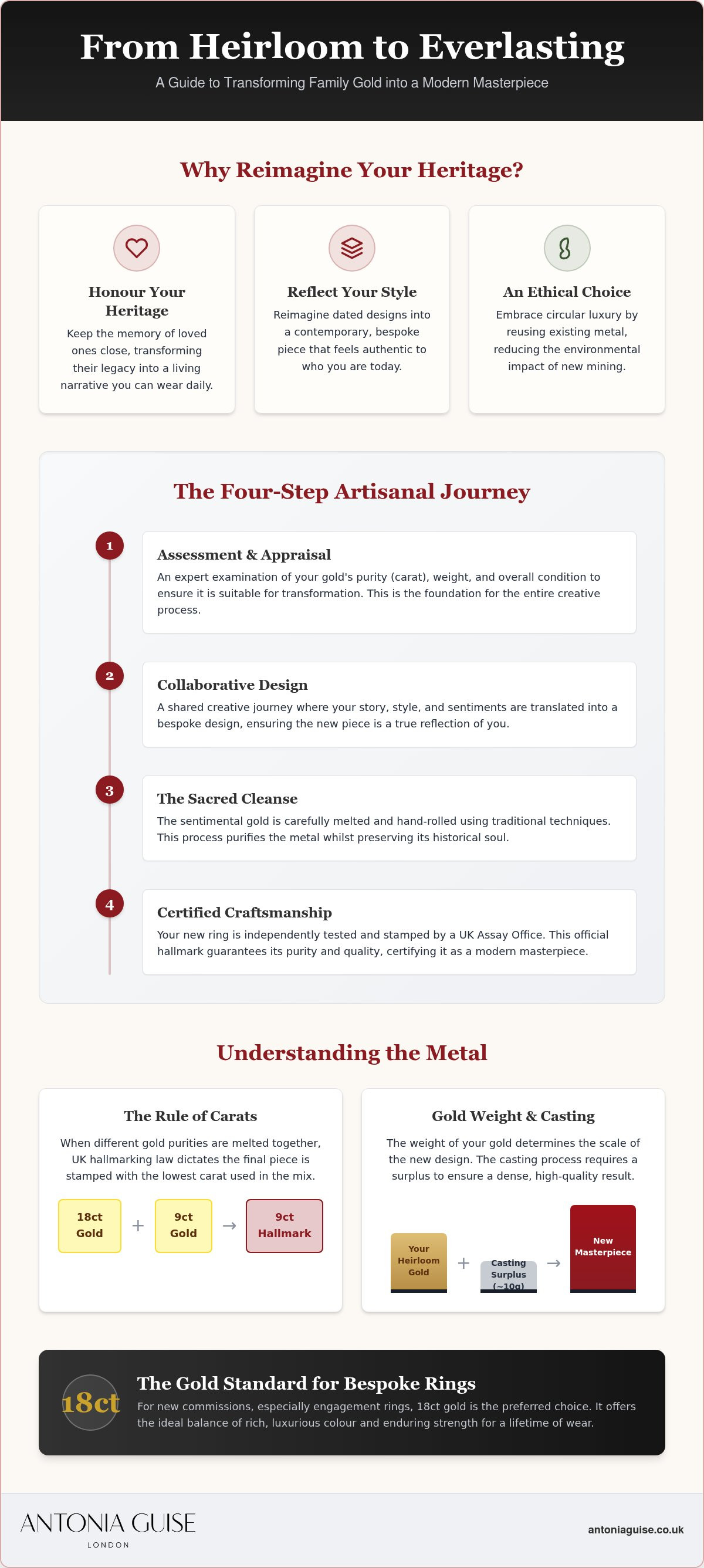
Repurposing family gold is the ultimate form of circular luxury. It's a deeply ethical choice that aligns with a more intentional, artisanal way of living. By reusing existing metal, we reduce the demand for newly mined gold, which often carries a heavy environmental and human cost. This process preserves existing beauty whilst ensuring a clear, sentimental provenance. During the initial assessment, we check the metal against gold purity standards to ensure it is suitable for the casting process. This technical rigour ensures your new ring is as durable and high-quality as it is meaningful.
Assessing Your Heirloom Gold: Purity, Weight, and Suitability
Before the creative spark can ignite, we must look closely at the physical heritage you've inherited. The assessment is a grounding moment where sentiment meets the practical reality of metallurgy. When you are considering using family gold to make a new ring, the first step is always an expert examination of the metal's purity and condition. This technical appraisal ensures that the "soul" of your jewellery can safely withstand the heat of the crucible and the pressure of the rolling mill.
The weight of your existing gold is the primary factor that determines the "volume" of your new design. It's a simple truth of physics: the more metal you provide, the more substantial the final piece can be. However, it's vital to remember that the casting process requires a surplus. We typically need around 10g of additional metal to act as a "button" in the mould, ensuring a clean and dense cast. If your collection of charms and broken chains doesn't quite reach the required weight, we can always supplement it with fresh gold that matches the purity of your originals. This is a common part of the jewellery remodelling journey, allowing us to maintain the integrity of your vision.
Understanding Carats and Hallmarking in the UK
In the UK, hallmarking is a legal requirement governed by the Hallmarking Act 1973. Every new piece of jewellery above one gram must be independently tested and stamped by an Assay Office. A crucial detail to understand is that if you mix different carats, the lowest purity in the melt usually determines the final hallmark. For instance, if we combine 9ct and 18ct gold, the final piece will be hallmarked as 9ct. For bespoke engagement rings, 18ct gold is the preferred choice because it offers an ideal balance of rich colour and enduring strength. If you're unsure about the marks on your pieces, we can help you decode the sponsor's mark and fineness stamps during your consultation.
Can You Mix Different Colours or Purities of Gold?
Whilst it's technically possible to blend different types of gold, it isn't always advisable. Mixing rose, yellow, and white gold into a single ingot can lead to "pitting" or brittle metal, which compromises the durability of the ring. It's often better to keep purities consistent to ensure a smooth, workable material. If you wish to change the final colour entirely, we can explore the gold refining process to return the metal to its purest state before alloying it again. If you're ready to see what's possible with your collection, you might find it helpful to book a bespoke design consultation to discuss your heritage pieces in detail.
The Creative Journey: Designing Your New Bespoke Ring
The process of using family gold to make a new ring begins long before the first flame touches the metal; it starts with a conversation about your history. This initial consultation is where you share the story behind your inherited pieces, allowing us to understand the legacy we're entrusted to carry forward. We then begin exploring engagement ring designs that resonate with your personal aesthetic, whether you're drawn to the clean lines of modern minimalism or the intricate details of a vintage-inspired silhouette. Through sketching and visualising, we map out the transformation of the metal and gemstones, finalising the "architecture" of the ring to ensure it remains a durable heirloom for another century.
Every design decision is made with intentionality. We consider how the width of the band, the height of the setting, and the placement of the stones will interact with your lifestyle. It's a methodical progression from inspiration to implementation. By the time we move to the workshop, we have a clear blueprint that balances your emotional desires with the concrete realities of fine jewellery craftsmanship. This ensures the final piece isn't just a ring, but a wearable chapter of your life story.
Visualising the Transformation
Moving from a vague idea to a concrete design requires a direct, heart-centred collaboration. We use mood boards and hand-drawn sketches to bridge the gap between your abstract memories and a physical reality. This phase is crucial for honouring the sentimental value of heirlooms whilst ensuring the new contemporary silhouette feels like a natural extension of your own identity. It's about finding the essence of the original piece and reweaving it into a design you'll want to wear every day. You aren't just a client in this process; you're a co-creator.
Incorporating Natural Gemstones
Natural diamonds and sapphires are the perfect companions for repurposed gold, offering a timeless brilliance that synthetic alternatives cannot match. The process involves delicately removing these stones from their old settings, a task that requires the steady hand of a master artisan to avoid damaging gems that may have hidden flaws or age-related wear. If your inherited piece lacks stones or you desire a more impactful look, we can carefully select additional natural stones to complement your inherited gems. This creates a cohesive, striking piece that remains deeply rooted in your family history without compromising on modern elegance.
The Technical Process: From Crucible to Craftsmanship
The transition from paper sketch to physical form is where the magic truly happens. When using family gold to make a new ring, we move into a methodical, slow-paced phase of traditional craftsmanship. It's a journey that respects the metal's history whilst preparing it for a fresh purpose. We start by gathering your pieces, the worn bands, the broken chains, the mismatched earrings, and preparing them for the crucible. This is where the technical rigour of the visionary storyteller meets the steady hand of the master artisan.
Melting Down and Refining the Metal
The "cleanse" is a high-temperature process where your old jewellery is transformed into a vibrant, liquid golden pool. It's a moment of profound symbolic power; the fire purifies the legacy of the metal, stripping away the wear of decades. Technically, this step is essential for removing old solder or base metal impurities that could compromise the strength of the final design. By refining the metal into a fresh ingot, we ensure that the new ring is structurally sound and free from the pitting or air bubbles that can plague mass-produced items. This liquid state is the ultimate blank canvas for your new chapter.
Hand-Fabrication vs. Casting
There are two primary paths for the metal once it leaves the crucible. Hand-fabrication is perhaps the most intimate method, where the ingot is annealed, a process of heating and cooling to soften the metal, and then hand-rolled or forged directly into shape. This tactile approach carries the marks of the maker and creates a piece that is uniquely dense and durable. However, for more complex or sculptural bespoke engagement rings, your family gold may be used as the raw material for a precision casting. In this instance, your gold is melted and poured into a bespoke mould created from a hand-carved wax model. Both methods ensure your ancestors' gold remains the heart of the piece, whether it's the primary material or a foundational seed in a larger creation.
The final stage of the technical journey involves rigorous quality control. We meticulously inspect the metal under magnification to ensure a flawless finish that reflects the light perfectly. This isn't just about aesthetics; it's about the integrity of the object. Every curve and setting is refined by hand, honouring the slow, careful pace of the artisanal process. If you're ready to begin the journey of using family gold to make a new ring, you can enquire about an heirloom transformation to discuss how we can bring your family stories back to life.
Commissioning Your Heirloom Story with Antonia Guise
At the heart of every transformation we undertake is the "Visionary Storyteller" approach, a philosophy that treats every commission as a shared emotional journey rather than a simple commercial transaction. We understand that using family gold to make a new ring is an act of profound trust, a decision to weave the threads of your past into the fabric of your future. We honour this trust by maintaining absolute artisanal integrity, utilising traditional techniques that have remained unchanged for centuries. Our commitment to natural gemstones and high-quality materials means we never use lab-grown diamonds, ensuring your piece possesses a genuine, earthy soul that mirrors the history of the metal itself. This is bespoke jewellery created with intentionality and heart.
The final reveal of your piece is a moment of quiet, celebratory reflection. It is the culmination of a methodical and graceful process, resulting in a design that feels entirely new yet deeply familiar. We don't believe in the coldness of traditional luxury; instead, we offer a warm, approachable partnership that guides you from the first spark of an idea to the physical reality of a finished masterpiece. Your ring will be a bold innovation, a contemporary piece that carries the confidence of expert craftsmanship whilst remaining intimately connected to your identity.
The Personalised Design Consultation
The journey begins with a dedicated space to discuss your heritage and vision. During this initial meeting, we encourage you to bring along photos, the gold itself, and the favourite stories that define your family history. It is here that we bridge the gap between abstract emotional desire and concrete creative action, sketching the first outlines of your new legacy. We maintain an unhurried, intentional pace throughout, reflecting the slow and careful nature of the handcrafted process itself. This direct collaboration ensures that the final design is a perfect visual communication of your personal milestone.
A Finished Piece for Future Generations
There is a lasting value in a one-of-a-kind commission that simply cannot be found in a shop window. Your new ring becomes the next chapter in an ongoing family narrative, a physical object that captures the essence of a well-told tale. It is a milestone celebration piece that you can wear with pride, knowing it is uniquely "you" whilst being firmly rooted in "them." By choosing an heirloom transformation, you are creating a piece of jewellery that is designed to endure, ready to be passed down to future generations as a testament to your family's enduring love and history.
Reimagining Your Heritage for the Modern Day
Choosing to breathe new life into inherited jewellery is more than a design choice; it's a commitment to preserving the narrative threads of your family history. We've explored the methodical journey of assessing purity, visualising a contemporary silhouette, and the artisanal "cleanse" in the crucible. Using family gold to make a new ring allows you to wear your ancestors' love every day, held in a form that is uniquely yours. Your story deserves to be told with intentionality and expert care.
Through direct collaboration with Antonia Guise, you'll benefit from a specialist in natural gemstones and the finest artisanal British craftsmanship. Every commission is a shared emotional journey that respects the tactile spirit of your past whilst celebrating your future. It's a way to ensure the chapters of your life are written in gold that carries a soul. Begin your heirloom transformation journey with a bespoke consultation and transform your forgotten treasures into a living legacy. The next chapter of your story is waiting to be forged.
Frequently Asked Questions
Can I use any type of gold to make a new ring?
Most solid family gold can be repurposed, though each piece requires a technical assessment. We typically work with 9ct, 14ct, 18ct, and 22ct gold. However, very fine chains or hollow items often contain a high proportion of solder, which can lead to impurities or "pitting" during the melting process. During your bespoke consultation, we'll examine your collection to ensure the metal is sound enough for a high-quality transformation that lasts a lifetime.
Is it cheaper to use my own gold for a new ring than buying a new one?
Using your own metal often reduces the material cost, but the primary investment in a bespoke commission lies in the artisanal labour and design expertise. Transforming family gold involves a complex journey of melting, refining, and hand-fabricating a unique piece. Whilst you're providing the raw material, the value comes from creating a one-of-a-kind masterpiece that captures your personal story, ensuring it's a far more meaningful investment than a mass-produced alternative.
What happens to the stones in my old family jewellery?
We delicately remove inherited gemstones from their original settings to be reimagined in your new design. Since we specialise in natural diamonds and gemstones, we treat these historical assets with the utmost care. It's important to note that older stones may have hidden flaws or wear, so we assess their structural integrity before resetting. Any stones not used in the new design are returned to you safely after the transformation is complete.
Will my new ring be hallmarked if it uses old family gold?
Yes, every piece we create that weighs over one gram must be independently hallmarked at a UK Assay Office. This is a legal requirement under the Hallmarking Act 1973. When using family gold to make a new ring, the final piece will receive a new hallmark reflecting its purity. For 2026, the optional date letter is 'B', providing a permanent record of when your family legacy was reborn into its contemporary form.
Can I mix white gold and yellow gold from different family pieces?
Whilst it's technically possible to blend different colours, we generally advise against mixing white, yellow, and rose gold in the same melt. Combining different alloys can lead to brittle metal or visible "pitting" in the finished surface. If you wish to change the final colour of your family gold, we can discuss the gold refining process to return the metal to its purest state before it's re-alloyed into your desired hue.
How much family gold do I need to make a standard ring?
The amount required depends on your chosen design, but we typically need more metal than the final ring's weight. During the technical process, some metal is lost to refining, and an extra 10g is often needed for the "casting button" to ensure a dense, high-quality finish. As a general guide, a standard band might require 5-8g of gold, but we'll provide a precise requirement once your bespoke design is finalised.
What if I don’t have enough gold for the design I want?
If your inherited collection doesn't provide enough volume for your vision, we can easily supplement it with fresh gold. We ensure the added metal matches the purity and colour of your original pieces perfectly. This collaborative approach allows you to achieve a more substantial or intricate design whilst still keeping your family’s sentimental gold at the very heart of the new ring’s physical and emotional structure.
How long does the process of transforming family gold take?
A bespoke heirloom transformation is a methodical journey that typically takes between eight to twelve weeks. This timeframe allows for the unhurried pace of the artisanal process, from the initial design consultation and sketching to the technical stages of melting and hand-fabrication. We also factor in the time required for independent hallmarking at the Assay Office, ensuring every detail of your new milestone piece is handled with the care it deserves.