
For generations, the classic white diamond has been seen as the ultimate symbol of commitment. It’s timeless, beautiful, and steeped in tradition. But what if your love story isn’t just classic and white? What if it’s vibrant, unique, and full of colour? If you’re nodding along, you’re in the right place. More and more couples are stepping away from the expected, choosing instead to mark their engagement with a splash of sapphire blue, a flash of ruby red, or the soft glow of a peach morganite.
A coloured engagement ring isn’t just a trend; it's a deeply personal statement. It’s a way to choose a stone that feels like you, one that tells a story no one else can. This guide is here to walk you through that exciting journey, helping you discover how to choose and design a ring that’s not just beautiful, but is a true reflection of your unique bond.
Beyond the White Diamond: Why We’re Falling for Colour
The move towards coloured engagement rings is about so much more than simply wanting something different. It’s a shift towards personal expression and storytelling. A white diamond is a beautiful, universal symbol of love, but a coloured gemstone can feel like a secret language between you and your partner—a hue that captures a shared memory, a favourite place, or the colour of their eyes.
This is where bespoke design truly shines. Instead of picking a ring from a display case, you get to be part of the creation. We can source a stone that feels like it was made just for you and design a setting that tells your story from every angle. The result is a ring that is completely, undeniably yours—a future heirloom that no one else in the world will ever have.
The Psychology of Colour in Fine Jewellery
Colour is emotion. The deep blue of the ocean can feel calming and infinite, whilst a sunny yellow can spark joy and optimism. When we choose a colour for an engagement ring, we’re tapping into that emotional power. It might be a sapphire that reminds you of the night sky on your first holiday together, or an emerald that captures the lush green of the countryside where you got engaged.
This is the heart of personal luxury. It’s not about a brand name; it’s about creating something that holds deep personal meaning. For modern couples, a coloured gemstone ring is becoming the new heirloom—a piece that carries not just value, but a rich, personal history from the very first day it’s worn.
Breaking Tradition, Honouring Legacy
Choosing a coloured stone might feel like a modern choice, but it’s actually a return to a rich history. For centuries, royals and aristocrats exchanged rings set with vibrant sapphires, rubies, and emeralds. These gems were symbols of power, wisdom, and passion long before diamonds became the standard.
By choosing a coloured engagement ring, you’re not abandoning tradition; you’re simply tapping into a different, older one. My role as your designer is to help you navigate this wonderful world, blending that sense of history with a design that feels fresh, modern, and perfectly suited to your life today.
Selecting Your Stone: Where Your Heart Meets Practicality
Falling in love with a gemstone is the easy part. The next step is making sure that stone is right for a piece of jewellery you’ll wear every single day. An engagement ring goes through a lot—from washing up and gardening to accidental knocks against a desk. This is where we need to balance your heart’s desire with a little bit of practical science.
One of the most important things we'll discuss is the soul of the stone itself. There's a certain magic to a natural gemstone, one that has been formed deep within the earth over millions of years. Each one has a unique 'fingerprint' of inclusions and colour variations that tell its story. For me, this natural artistry is what gives a bespoke piece its character and life, a quality that simply cannot be replicated in a lab.
The Mohs Scale: Your Practical Guide for Engagement Rings
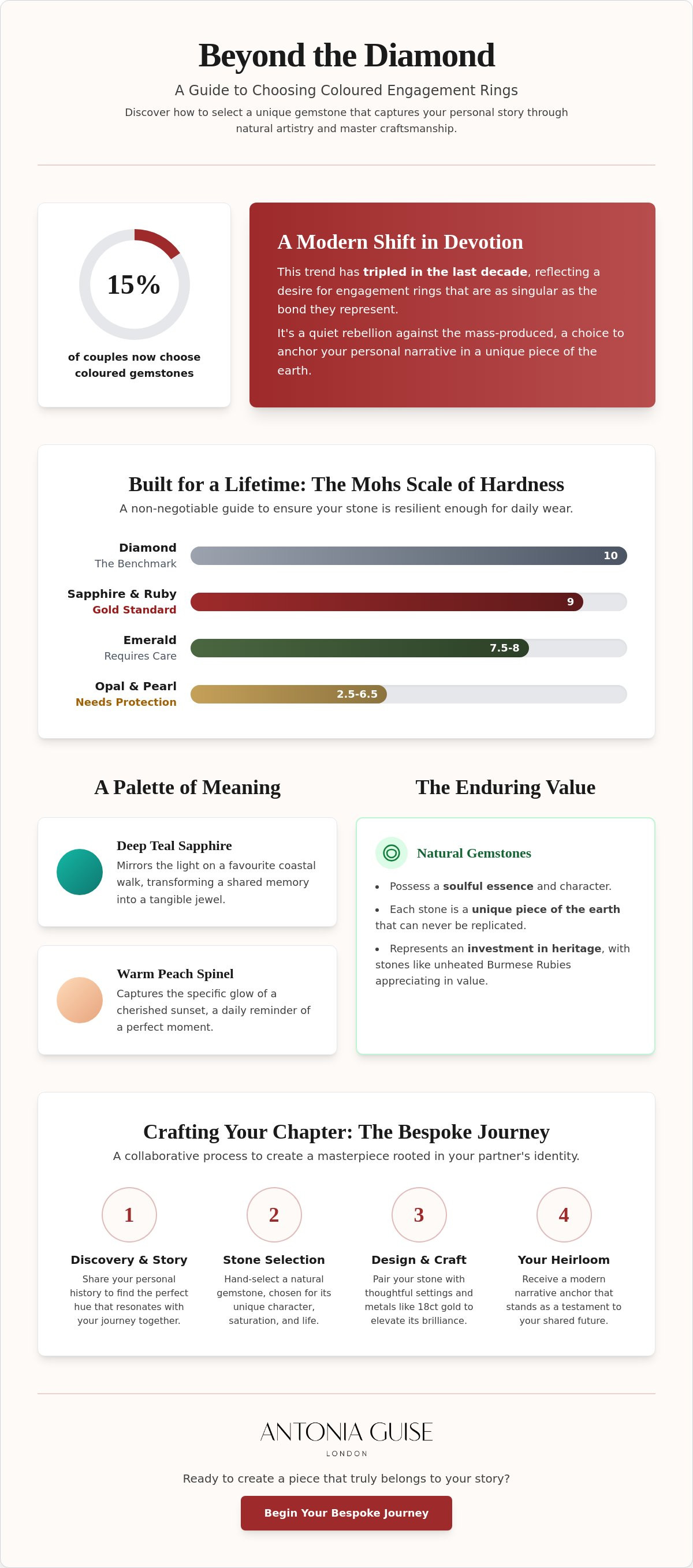
Let's talk about something incredibly important but often overlooked: the Mohs Scale of Hardness. It’s a simple 1-10 scale that measures a gemstone's resistance to scratching. A diamond scores a perfect 10, making it the toughest of them all. For a coloured engagement ring intended for daily wear, you’ll want a stone that’s as high up on that scale as possible.
- The Gold Standard (after diamonds): Sapphires and Rubies are your best friends here. They are both part of the Corundum mineral family and score a 9 on the Mohs scale. This makes them exceptionally durable and perfect for withstanding the rigours of everyday life.
- Beautiful but Be Cautious: Stones like Emeralds (7.5-8) and Spinels (8) are also wonderful choices, but they require slightly more mindful wear. Emeralds, in particular, often have natural inclusions that can make them more vulnerable to impact.
- The Softer Stones: I know how tempting it can be to fall for the ethereal fire of an Opal (5.5-6.5) or the classic lustre of a Pearl (2.5-4.5). Whilst beautiful, these gems are very soft and porous, making them unsuitable for a ring worn every day. That doesn’t mean you can’t use them; it just means we’d design them into a special occasion piece, like a pendant or earrings, where they’ll be safe from harm.
The Artistry of Natural, Earth-Mined Gems
In a world of mass production, there is something truly special about a gemstone created by nature. Lab-grown stones can be chemically identical, but they lack the history and the subtle imperfections that give a natural gem its soul. Those tiny inclusions or unique zones of colour aren't flaws; they are the stone’s birthmarks, proof of its incredible journey from deep within the earth to your hand.
When you work with me, you’ll only ever see natural, earth-mined stones. I believe their history and rarity are part of their beauty. We don't search for a "perfect" stone; we search for a stone with character—one that speaks to you and feels truly alive.
A Palette of Meaning: Popular Gemstones for Bespoke Designs
Now for the fun part: exploring the beautiful world of coloured gemstones. Whilst the options are nearly endless, a few have proven themselves to be enduring favourites for engagement rings, loved for both their beauty and their resilience.
We’ll explore the "Big Three"—Sapphire, Ruby, and Emerald—as well as some other brilliant contenders. The goal isn't just to find a pretty colour, but to find a hue that complements your skin tone, suits your personal style, and resonates with the story you want to tell.
Sapphires: The Versatile Soul of the Coloured Ring
When you think of a sapphire, you probably picture a deep, velvety cornflower blue. But that’s just the beginning of the story. Sapphires come in almost every colour of the rainbow—from soft pinks and sunny yellows to incredible teal, green, and peachy-pink 'Padparadscha' sapphires. For those beginning their search, looking at loose blue sapphires for sale can help you refine the exact shade of blue that speaks to you.
This versatility, combined with their exceptional durability (a 9 on the Mohs scale), makes sapphires the ultimate choice for a coloured engagement ring. They offer the perfect blend of personality and practicality. Whether you’re drawn to a classic three-stone 'Trilogy' design or something more contemporary, a sapphire provides a stunning and steadfast centrepiece.
Rubies and Emeralds: Bold Statements of Passion and Growth
There is nothing quite like the fire of a natural ruby. It’s a stone that symbolises passion, devotion, and courage—a truly bold and romantic statement. A rich, red ruby feels both classic and powerful, and it looks breathtaking when paired with the warmth of yellow gold or the crisp contrast of platinum.
Emeralds, known as the "Stone of Successful Love," have a deep, captivating green that feels alive. Their natural inclusions, often called the 'jardin' (garden), are part of their unique charm. Because they are a little more delicate than sapphires, we often design emerald rings with more protective settings, like a bezel or a halo, to keep them safe whilst showcasing their incredible colour.
The Rarity of Coloured Diamonds
For the ultimate in luxury and rarity, there are natural coloured diamonds. These are not to be confused with the gemstones above; they are diamonds that have formed with a natural hue. From soft champagne and sunny yellow to the extraordinarily rare pink, these stones are in a league of their own.
A fancy coloured diamond combines the unmatched hardness of a diamond with a unique splash of personality, making it a truly remarkable choice for a milestone celebration or an engagement ring that is destined to become a legendary family heirloom.
Designing with Colour: Metal Pairings and Setting Styles
Once you’ve found your perfect stone, the next step is to create its home. The metal you choose and the style of the setting have a huge impact on the final look and feel of your ring. This is where we play with light, proportion, and texture to make your central stone sing.
The right metal can completely change the personality of a gemstone. It’s not just a structural element; it’s part of the artistry. Here’s how different metals can influence your design:
- 18ct Yellow Gold: Think of yellow gold as a warm hug for your gemstone. It has a rich, classic feel that beautifully enhances the warmth in stones like rubies and emeralds, and it creates a stunning, vibrant contrast with deep blue sapphires.
- Platinum and White Gold: These cool, white metals act like a crisp, clean canvas. They make colours pop, bringing out the icy brilliance of aquamarines or the cool tones in a teal sapphire. They offer a modern, sophisticated feel.
- Rose Gold: With its soft, pinkish hue, rose gold has a wonderfully romantic and slightly vintage appeal. It’s a perfect partner for warm-toned gems like morganites, pink sapphires, and champagne diamonds.
The Architecture of the Setting
The setting does two crucial jobs: it holds your stone securely and it showcases its beauty. The style you choose can define the ring’s entire character. A popular topic of discussion is how to best frame a gemstone, something we explore in detail when looking at different shapes like those in the architecture of square engagement rings.
- Claw vs. Bezel Settings: A traditional claw (or prong) setting lifts the stone up, allowing light to enter from all sides for maximum sparkle. A bezel setting, where a thin metal rim encases the stone’s edge, offers a more modern look and provides excellent protection, making it a great choice for softer stones like emeralds.
- Halo Designs: A halo of small diamonds around the centre stone is a brilliant way to make it appear larger and add a serious dose of sparkle. It creates a luminous frame that draws the eye directly to the colour at the heart of the ring.
- The 'Toi et Moi' Style: French for "You and Me," this deeply romantic design features two central stones side-by-side. It’s a beautiful way to represent your partnership, perhaps pairing your two different birthstones or simply two coloured gems that you love together.
Complementary Side Stones
Side stones are the supporting cast that helps your main gemstone shine. They can add light, shape, and extra meaning to your design. We often use small, natural white diamonds as side stones because their neutral sparkle provides a beautiful contrast that intensifies the central colour.
Whether we choose the sleek, geometric lines of tapered baguettes or the soft curves of pear-shaped diamonds, the key is to ensure they complement, rather than compete with, your main stone. It’s all about creating a balanced, harmonious design where every element works together to tell your story.
Our Journey Together: The Antonia Guise Bespoke Experience
This is where your story truly comes to life. A bespoke commission is a partnership. It’s not about me telling you what to have; it’s about us discovering it together, from the first chat over coffee to the moment you hold your finished ring. It’s a creative, collaborative, and deeply personal process.
My approach is built on the belief that jewellery should be as unique as the person wearing it. We’ll sit down together, talk about your life, your style, and the feelings you want your ring to evoke. I’ll source a small, curated selection of exquisite natural gemstones for you to see and handle in person, so you can choose the one that truly calls to you. To understand this process in more depth, you might enjoy reading this guide to one-of-a-kind engagement rings.
The Heirloom Transformation Process
One of the most meaningful parts of my work is helping clients transform inherited jewellery. Perhaps you have a grandparent’s ring that holds immense sentimental value but doesn’t quite feel like your style. We can honour that history by carefully unsetting the family stones and gold and breathing new life into them within a modern coloured engagement ring design.
This process is a delicate art, blending the old with the new to create something that carries the love of the past into the future. It's a beautiful way to ensure your family’s story continues to be told, in a way that feels authentic to you.
Commencing Your Bespoke Journey
Are you ready to create something truly extraordinary? The first step is simply to get in touch. We can arrange a consultation to chat about your ideas, with no pressure or expectation. Bring your daydreams, your saved images, and your questions.
Together, we will explore a world of colour, craftsmanship, and personal storytelling to create a coloured engagement ring that is more than just a piece of jewellery—it will be a tangible piece of your love story, crafted to last a lifetime and beyond.
Once your bespoke ring is complete, the next step in your journey might be to visit a luxury boutique like Brides in Love to explore Sima Couture Gowns and find a wedding dress that reflects the same level of luxury and personal style.
Begin your romantic design journey with a bespoke consultation.
Frequently Asked Questions
-
Which coloured gemstone is best for an engagement ring?
For durability and beauty, sapphires and rubies are the top choices. They score a 9 on the Mohs scale, making them tough enough for daily wear. Spinel and aquamarine are also great options, whilst emeralds are beautiful but require a more protective setting.
-
Are coloured engagement rings more expensive than diamond rings?
It varies hugely! The price of a coloured gemstone depends on its rarity, size, colour saturation, and clarity. A very fine, rare sapphire could be more expensive than a diamond of a similar size, but it's also possible to find a beautiful coloured gemstone for a more accessible price point. It's all about finding the right balance for you.
-
How do I care for a coloured gemstone ring?
Most gemstone rings can be cleaned gently at home with warm, soapy water and a soft toothbrush. It's also wise to remove your ring during heavy-duty activities, swimming, or when using harsh chemicals. For softer stones like emeralds, it's best to avoid ultrasonic cleaners.
-
Can I use an inherited stone for a bespoke coloured engagement ring?
Absolutely. This is one of my specialities. We can carefully assess your heirloom stone and design a beautiful new ring around it, honouring its history whilst creating a piece that’s perfect for you today.
-
Do coloured engagement rings go out of fashion?
Not at all. In fact, they are a return to a very old tradition. A well-designed ring featuring a classic stone like a sapphire, ruby, or emerald is timeless. Because your ring will be designed to reflect your personal story, it will never feel dated—it will always feel like you.
-
What is the most durable coloured gemstone for daily wear?
Sapphires and rubies are the most durable. As part of the corundum family, they are second only to diamonds in terms of hardness, making them the ideal choice for a ring you’ll wear for a lifetime.
-
How long does a bespoke coloured ring commission take?
The bespoke journey is a thoughtful one. From our initial consultation and stone sourcing to the final crafting, the process typically takes around 8-12 weeks. This ensures we have ample time to perfect every single detail.
-
Should I choose a natural stone or a lab-grown gemstone?
This is a personal choice, but my philosophy and expertise lie with natural, earth-mined gems. I believe their rarity, unique character, and the millions of years of history held within them give them a soul and a value that cannot be replicated in a laboratory.