
What if that heavy gold brooch tucked away in your bedside drawer wasn't a source of guilt, but the beginning of a new chapter? You likely feel a profound responsibility to protect these pieces, yet you find yourself wondering what to do with inherited jewellery I don't wear because the aesthetic simply doesn't reflect who you are today. It is a delicate balance to strike, weighing the heavy anchor of tradition against the desire for something that resonates with your personal spirit.
We understand that the true value of an heirloom often comes from the stories it carries rather than the gemstones it holds. This guide will help you journey through the emotional and practical complexities of your collection, moving from the anxiety of safekeeping toward the joy of bespoke transformation. We shall explore how to honour the essence of your family legacy whilst creating a contemporary heirloom that you will feel proud to wear every single day, ensuring the love of previous generations finds a beautiful, modern expression.
Key Takeaways
- Shift your perspective from guilt to inspiration by redefining inherited pieces as living vessels for memory rather than static burdens of the past.
- Identify the most thoughtful paths for your collection, whether that involves professional maintenance for sentimental preservation or gifting to a relative whose style aligns with the piece.
- Discover exactly what to do with inherited jewellery I don't wear through the creative process of remodelling, which breathes new life into natural gemstones and precious metals.
- Learn how to evaluate your items for high-quality materials, such as 18ct gold and platinum, to determine their potential for a bespoke transformation.
- Understand the collaborative philosophy of working with a master artisan to ensure the original spirit of your family heirloom remains at the heart of its new design.
The Emotional Weight of Inherited Jewellery: Why We Keep What We Don't Wear
Jewellery is rarely just metal and stone; it is a physical manifestation of a moment, a person, or a promise. When we ask ourselves what is an heirloom?, we are really looking for the thread that connects us to our ancestors. These pieces act as vessels for memory, holding the echo of a mother's laughter or the quiet strength of a grandmother's presence. They are chapters of a story we aren't ready to close, yet they often sit in silence.
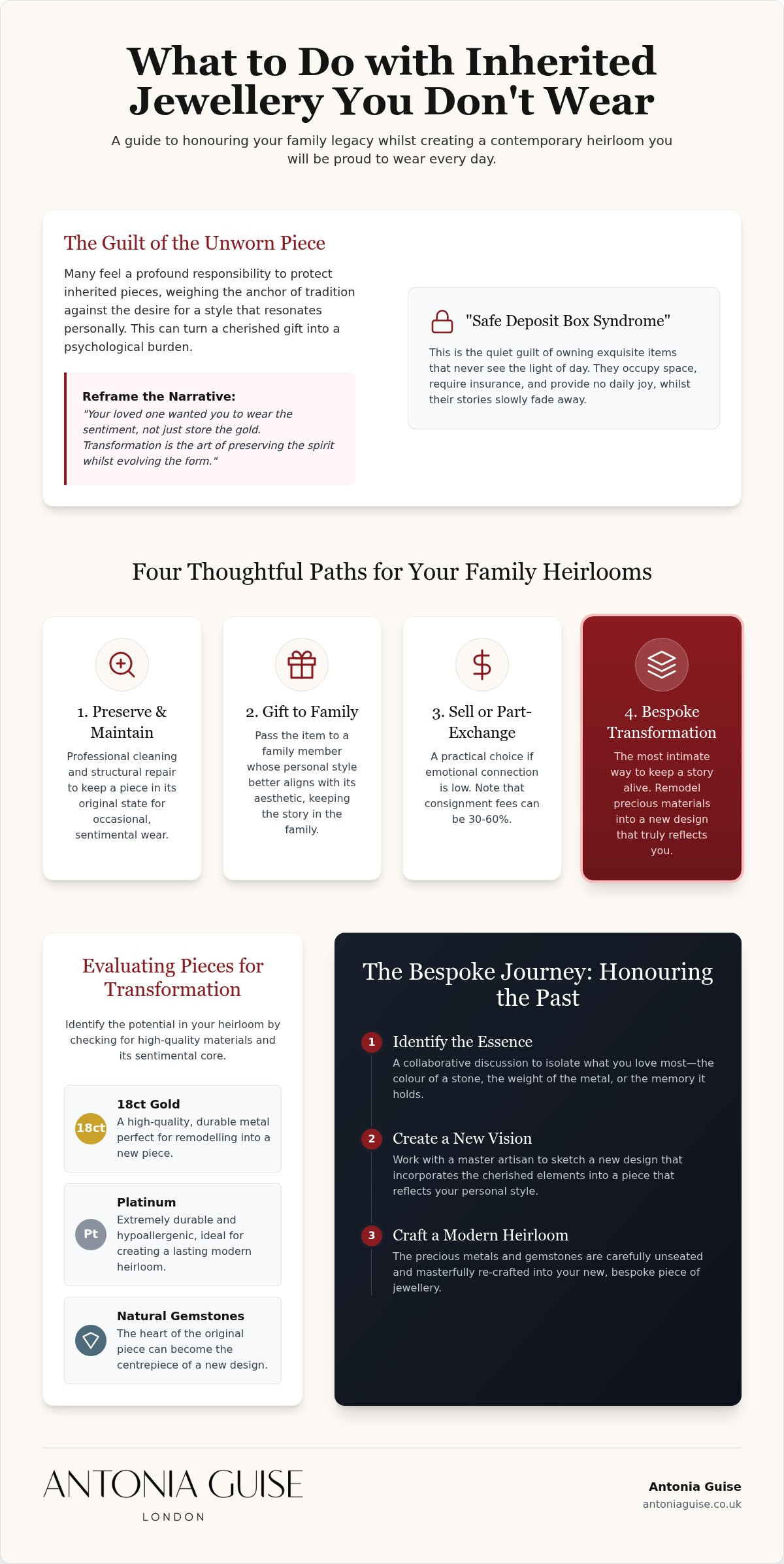
Many of us suffer from 'Safe Deposit Box Syndrome.' This is the quiet guilt of owning exquisite items that never see the light of day. You might feel a heavy sense of responsibility to keep these items exactly as they were, even if they don't suit your lifestyle or your personal aesthetic. When you constantly wonder what to do with inherited jewellery I don't wear, the items transition from being a cherished gift to becoming a psychological burden. They occupy space in your mind and your safe, requiring insurance and security, yet they provide no daily joy. Jewellery is a living legacy. It requires movement, light, and the warmth of skin to truly honour the person it came from.
Understanding the Guilt of the Unworn Piece
There is a common fear that altering a piece of jewellery is an act of erasure or disrespect. You might worry that by changing the setting, you are somehow 'destroying' the legacy of the person who wore it before you. It's vital to reframe this narrative. Your loved one gave you that piece because they wanted you to feel cherished, not because they wanted to hand you a permanent obligation. They wanted you to wear the sentiment, not just store the gold.
Doing nothing carries its own cost. Beyond the practicalities of insurance premiums and the risk of loss, there is the emotional cost of the story fading away. When a piece is hidden, its history is eventually forgotten. Bringing it into the light ensures the narrative continues for another generation.
Identifying the Sentimental Essence
To move forward, you must identify what truly resonates within the piece. Is it the deep blue of the sapphire, the weight of the 18ct gold, or simply the memory of the occasion it represents? There is a profound difference between the physical form of the jewellery and the spirit of the gift itself. Once you isolate the essence, you can begin to imagine a new future. Heirloom transformation is the art of preserving the spirit whilst evolving the form. By focusing on the elements you truly love, you can decide what to do with inherited jewellery I don't wear in a way that feels celebratory rather than clinical.
Four Thoughtful Paths for Your Family Heirlooms
Deciding what to do with inherited jewellery I don't wear is a journey that requires both heart and pragmatism. You are not merely managing assets; you are deciding how a family story should continue. There are four primary avenues to consider, each offering a different way to handle the legacy you've been entrusted with. First, preservation and maintenance involve a professional cleaning and structural repair, perfect for pieces you wish to keep original for occasional, sentimental wear. Second, gifting allows you to pass the item to a family member whose personal style better aligns with the vintage aesthetic, ensuring the piece stays within the family circle.
The third path is selling or part-exchange, which is often the most practical choice when the emotional connection is low. Finally, a bespoke transformation offers the most intimate way to keep a story alive. This process allows you to retain the precious materials whilst creating a design that truly reflects your identity. If you feel ready to explore these possibilities, you might consider how collaborating with a designer can clarify your vision.
When to Consider Selling Inherited Jewellery
Selling a family piece is a significant decision. Sometimes a piece carries historical weight or rare hallmarks, such as 18ct gold or platinum stamps, that might make it a museum-quality item too important to alter. It's vital to understand the difference between 'scrap value' and 'retail value' before proceeding. As of September 2026, gold prices remain high at approximately $4,311 per troy ounce, but a dealer will typically offer a price based on the raw metal weight. If you choose consignment, expect fees to range between 30% and 60% of the final sale price. Selling should generally be a last resort for items with deep family ties, as the narrative of the piece is lost once it leaves your hands.
The Power of the Jewellery Transformation
For many, the most soulful way to resolve the question of what to do with inherited jewellery I don't wear is through jewellery remodelling. This path is particularly poignant for milestone celebrations like a landmark birthday or an anniversary. A transformation allows you to weave multiple family stories into a single contemporary design. You might take a natural diamond from your grandmother's brooch and set it alongside sapphires from your mother's earrings. This approach is inherently sustainable, as it breathes new life into existing natural gemstones and gold from your family archive, reducing the need for new mining whilst honouring the original spirit of the gift.
Modernising Memories: The Art of Jewellery Remodelling
Remodelling is far more than a technical service; it's a bridge between eras. When you find yourself contemplating what to do with inherited jewellery I don't wear, the most profound answer often lies in the art of transformation. This process begins with the delicate extraction of natural gemstones from their original, perhaps dated, settings. It isn't about discarding the past. It's about liberating the stones so they can shine in a way that suits your life today. We treat every stone with the reverence it deserves, acknowledging that it has already witnessed a lifetime of stories before reaching our workshop.
A skilled designer doesn't just melt metal; they look for the original design motifs—perhaps a specific curve or a unique setting style—and weave them into a new, modern silhouette. This collaborative journey is essential to the process. You aren't just a client; you're the co-author of this new chapter. This partnership provides the emotional permission many need to change a family piece, ensuring the soul remains intact whilst the form evolves. By working together, we ensure that the finished piece feels like a natural progression of your family's narrative rather than a departure from it.
From Outdated to Outstanding: Design Styles
The possibilities for your collection are as vast as your family history itself. You might choose to turn a heavy, ornate brooch that feels too formal for your wardrobe into a delicate pendant for daily wear. If you've inherited stones from several different relatives, these can be combined into a 'family cluster' ring that represents your entire lineage in one striking design. For those seeking a more contemporary engagement ring design, transitioning from traditional yellow gold to platinum can completely redefine the piece's character whilst maintaining its sentimental core.
The Ethics of Natural Stones in Remodelling
We choose to work exclusively with natural diamonds and gemstones because they carry a unique geological story that began billions of years ago. These stones are finite treasures of the earth, making them far more than just decorative objects. Lab-grown alternatives simply cannot replicate the weight of history found in an old-cut stone, such as a Mine or European cut. These artisanal cuts were shaped by hand, often under candlelight, giving them a soft, romantic glow that modern machine-cut stones lack. By choosing to reuse these natural materials, you ensure the new piece remains a high-value investment and a meaningful heirloom for future generations. It's a way of deciding what to do with inherited jewellery I don't wear that respects both the planet and your personal heritage.
Evaluating Your Inherited Pieces for Transformation
Before the creative process of design can begin, a practical assessment of your collection is essential. You might feel overwhelmed by a velvet-lined box of disparate items, unsure of what holds true value and what is merely costume. Understanding the raw materials at your disposal is the first step in deciding what to do with inherited jewellery I don't wear. A bespoke jeweller acts as a trusted guide during this phase, providing a professional assessment of your items to determine their suitability for a new life. They will look beyond the surface, identifying the potential in every natural diamond and every gram of precious metal.
Metal purity is a foundational element of this evaluation. Look for hallmarks such as '750', which denotes 18ct gold, or '950' for platinum. These markings are the signatures of quality, confirming that the metal can be refined or repurposed into a contemporary silhouette. The condition of the stones is equally vital. Whilst diamonds are incredibly resilient, they may have gathered tiny chips on the girdle over decades of wear. Coloured gemstones might appear dull due to surface scratches. In many cases, professional re-polishing can restore their original lustre, making them appear as vibrant as the day they were first set.
A Guide to Assessing Your Gemstones
When evaluating natural diamonds, look for the unique charm of antique cuts. Old Mine or European cuts possess a romantic, hand-carved quality that modern machine-cut stones cannot replicate. Coloured stones like sapphires and rubies are generally durable enough to survive a reset, though delicate emeralds require a more cautious approach. To truly appreciate the potential of your gems, observe them under natural light to look for 'fire' and 'life' within the depths of the stone. These natural treasures carry a geological history that deserves to be seen and celebrated once more.
Preparing for Your Design Consultation
A bespoke transformation is a collaborative journey, and preparation helps set the narrative for your new piece. We encourage you to gather photographs of the original owner wearing the jewellery; these images help us understand the spirit of the person we are seeking to honour. It is also helpful to decide which milestone this new creation will celebrate, such as a landmark birthday or a new birth. Setting a realistic budget early on allows us to design with intention, whether you are seeking a complete bespoke commission or a refined reset of a single stone. If you are ready to begin this intimate process, you can book a consultation with Antonia Guise to discuss the future of your collection.
The Bespoke Journey: Honouring the Past with Antonia Guise
The transformation of a family piece is a deeply personal odyssey. At the heart of our philosophy is the belief that you are the co-author of this new chapter. We don't simply take your stones; we invite you into the creative sanctum where your memories meet our craftsmanship. This collaborative spirit ensures that the final resolution of what to do with inherited jewellery I don't wear is an act of creation rather than just a technical task. It is a shared emotional journey that treats every project as a milestone in its own right.
The journey begins with the Initial Discovery, a time for sharing the history of your pieces and your vision for their future. Next is the Design Phase, where we begin visualising how your old stones will sit within a bespoke engagement ring or a commemorative milestone piece. Following this, The Craft takes centre stage as we use traditional British artisanal techniques to forge your new design by hand. Finally, The Reveal is that breathless, emotional moment when you see a loved one's legacy reborn as a piece you can truly call your own. It's the moment the story continues.
Why Direct Collaboration Matters
A high-street 'remount' often feels clinical and detached, treating your heirloom like a standard component in a mass-produced setting. In contrast, a bespoke transformation is about finding a soulful match between the history of the materials and your unique personality. Direct collaboration with the designer ensures that every curve of the metal and every setting choice reflects your spirit. You deserve the reassurance of working with an artisan who values the emotional weight of your collection as much as you do. It is a partnership built on trust and a shared respect for the passage of time.
Creating the Next Heirloom
By choosing this path, you aren't just solving the problem of what to do with inherited jewellery I don't wear; you're intentionally creating the next heirloom for the next generation. Using natural diamonds and precious metals like 18ct gold or platinum ensures the piece will endure for another century, ready to be passed down with a new story attached. We encourage you to take these treasures out of the darkness of the safe and let them become part of your daily life. Honour the legacy by wearing it, loving it, and allowing it to witness your own milestones as it did for those who came before you. Your history is meant to be worn.
Breathe New Life into Your Family Story
Inherited treasures are more than just physical assets; they are the silent witnesses to your family's most cherished chapters. By choosing to transform these pieces, you move beyond the static guilt of owning items you never use and embrace a future where your legacy is worn with pride. You've learned how to evaluate your natural gemstones and precious metals, ensuring that the artisanal value and sentimental essence of your collection remain protected throughout the creative process.
Deciding what to do with inherited jewellery I don't wear is an invitation to become a visionary storyteller. Whether you are combining stones from multiple generations or reimagining a single heirloom, the goal is to create a contemporary design that feels like a soulful match for your identity. We invite you to book a consultation to begin your heirloom transformation journey with Antonia Guise. Our bespoke designs are tailored to your family story, featuring expert handling of natural gemstones and artisanal techniques handcrafted in the United Kingdom. Your history is a gift; let us help you wear it beautifully every day.
Frequently Asked Questions
Is it disrespectful to change the design of inherited jewellery?
It is not disrespectful to evolve the form of a family piece; rather, it is an act of preservation that ensures the item remains a living part of your life. When you consider what to do with inherited jewellery I don't wear, remember that the original giver intended for the gift to bring you joy. By resetting stones into a contemporary silhouette, you are protecting the sentiment whilst allowing the piece to witness your own milestones.
Can I combine multiple pieces of inherited jewellery into one new design?
You can certainly weave multiple family stories into a single design. Combining natural gemstones from various relatives, such as a grandmother's diamond and a mother's sapphire, creates a rich, layered narrative. This approach allows you to wear your entire lineage in one bespoke piece. During our collaborative process, we explore how different stones can harmonise within a new setting, ensuring each individual history is respected whilst forming a cohesive and beautiful contemporary heirloom.
What happens to the leftover gold or metal from my old jewellery?
Any gold or precious metal not used in your new design can be handled in several ways. We can often refine and recycle your original 18ct gold or platinum to forge the new setting, maintaining the physical connection to the past. If the metal is not suitable for direct reuse, it can be credited against the cost of your commission. This ensures that every element of your inheritance is used purposefully, reducing waste and honouring the material's value.
How do I know if the diamonds in my inherited ring are natural?
Identifying natural diamonds requires a professional assessment using specialist equipment. We focus exclusively on natural gemstones and do not work with lab-grown alternatives. During your initial consultation, we examine your pieces for traditional characteristics and antique cuts like Old European or Mine cuts. These hand-carved facets are often a hallmark of genuine historical stones. If required, we can arrange for formal certification to confirm the geological origin and quality of your inherited diamonds.
Is it more expensive to remodel jewellery than to buy something new?
Remodelling is an investment in craftsmanship rather than just raw materials. Whilst bespoke work involves high-value design fees, you often save significantly by providing your own natural diamonds and gold. Buying a new high-end piece includes the retail markup of new stones, whereas a transformation focuses the budget on artisanal techniques and a personalised story. It is a sustainable way to acquire a one-of-a-kind piece that holds far more emotional weight than a mass-produced item.
Can you use the original engravings or hallmarks in a new piece?
Whilst the physical metal is often refined to ensure structural integrity, we can certainly incorporate original motifs or recreate significant engravings in the new design. If a specific hallmark or inscription is vital to the story, we look for creative ways to preserve that element, perhaps by setting it into the inside of a new band. This ensures that the technical and sentimental markers of the original piece continue to be part of its future chapters.
How long does the heirloom transformation process typically take?
The journey from initial discovery to the final reveal typically takes between 8 and 12 weeks. This timeframe reflects the methodical and intentional pace of our handcrafted process, allowing for direct collaboration during the design phase and careful artisanal work in the workshop. We prioritise quality and intentionality over speed, ensuring that every detail of your transformation is perfect. We will provide a specific timeline once your design is finalised and the stones are assessed.
What if I don't have a specific design in mind for my inherited stones?
Most clients begin their journey without a clear vision, and that is exactly where our expertise as a trusted guide begins. When you aren't sure what to do with inherited jewellery I don't wear, we start with the stones and the stories they carry. Through collaborative sketching and conversation, we explore your personal aesthetic and the spirit of the original pieces. We help you discover a design that feels like a natural extension of your identity.